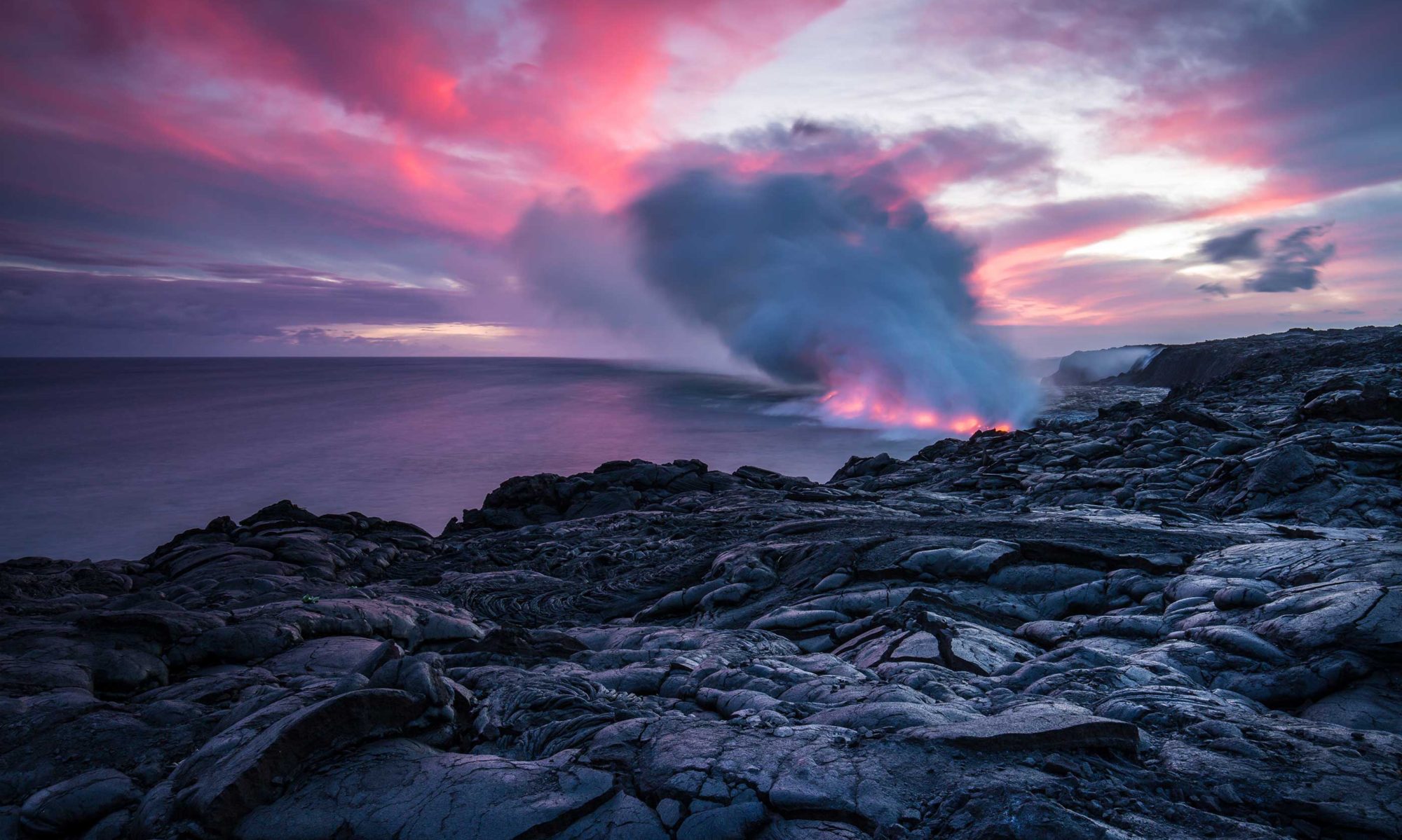

In seafloor trenches around the world, slabs of oceanic crust fall slowly into the mantle, while new slabs are formed at mid ocean ridges, where magma emerges at the seams separating tectonic plates. Beginning about 15 million years ago, ocean crust production declined by a third over 10 million years to a slow pace that continues to today.
Continue reading “Plate tectonic slowdown”Recycling of oceanic crust
In plate tectonics, there are three categories of volcanism: ocean ridge, arc and intraplate. While the origins of ocean ridge and arc volcanism are readily explained by plate tectonics, intraplate volcanism (IPV) is not. The dominant hypothesis for the origins of IPV is by mantle plumes from deep within the interior of the earth.
Continue reading “Recycling of oceanic crust”Early magma ocean
New research by the University of Cambridge has found evidence in ancient rocks from Greenland that the Earth was at a time almost entirely molten. The study yields information on an important period in our planet’s formation when a deap sea of magma stretched across Earth’s surface and extended hundreds of kilometers into the interior.
Continue reading “Early magma ocean”Mountainless Earth
According to a study published in the journal Science, for nearly a billion years during our planet’s “middle age” (1.8 billion to 0.8 billion years ago), Earth’s mountains stopped growing while erosion wore down existing peaks to stumps. This extreme mountain-forming hiatus resulted from a persistent thinning of Earth’s continental crust.
Continue reading “Mountainless Earth”Ice free Greenland
Scientists have discovered that the Greenland ice sheet has melted to the ground at least once in the last million years despite CO2 levels far lower than today. This ice sheet holds enough frozen water to swamp coastal cities worldwide.
Continue reading “Ice free Greenland”River of rocks
Geologists have previously thought that tectonic plates move because they are pulled by the weight of their sinking regions and that an underlying, hot, softer layer called the asthenosphere acts as a passive lubricant. Now a team of geologists at the University of Houston has found that layer is flowing swiftly, moving fast enough to drive plate motions.
Continue reading “River of rocks”Ancient water world
Over time, sea levels have risen and fallen but Earth’s total surface water was assumed to be constant. New evidence indicates that some 3 billion to 4 billion years ago, the planet’s oceans held nearly twice as much water. This could have initiated the mechanism of plate tectonics and made it more difficult for life to start on land.
Continue reading “Ancient water world”Earth’s inner-inner core
New research led by Jo Stephenson at Australian National University in Canberra has revealed that there may be a hidden layer inside the Earth’s solid inner core. It is believed that it could have something to do with changes in the structure of iron under extreme temperature and pressure. The study shows that there may be more complexity to the inner core than previously thought.
Continue reading “Earth’s inner-inner core”Laschamp excursion record in tree rings
A team led by Alan Cooper found a detailed record of the Laschamp excursion about 41,000 years ago from the rings of New Zealand swamp kauri trees. The record reveals a substantial increase in the carbon-14 content of the atmosphere during the period of weakening magnetic field strength preceding the polarity switch.
Continue reading “Laschamp excursion record in tree rings”Missing ice problem solved
During glacial periods, the sea level falls, because large quantities of water are stored in the massive inland glaciers. Until now, however, computer models have been unable to reconcile sea-level height with the thickness of the glaciers. Using new calculations, a team of climate researchers led by the Alfred Wegener Institute has now managed to explain this difference.
Continue reading “Missing ice problem solved”